Thursday, October 10, 2013

MAD ABOUT MARIONETTES: THE BOB BAKER THEATER


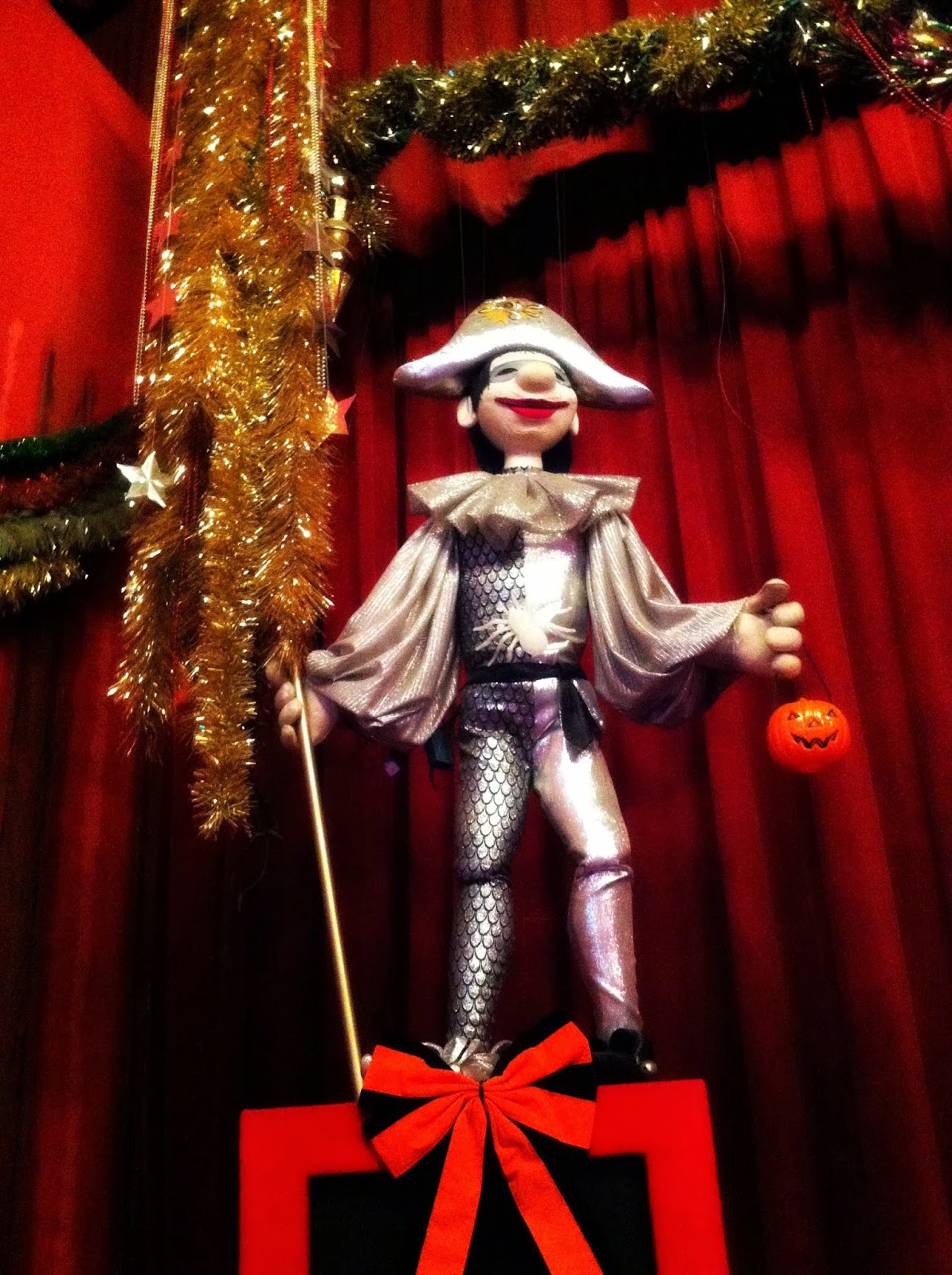
 In a world of high-tech everything, where we freak out if something takes more than two seconds to download (or maybe that’s just me?), there is something incredibly charming about the simplicity of the Bob Baker Theater. But simple does not mean boring, as my delighted three-year-old and I will tell you after our recent visit for the Halloween Hoop-De-Doo, one of the theater’s most popular offerings that is running through November 3rd.
Bob Baker has been a puppeteer and marionette maker since the 1940s, and has created puppets for iconic films like A Star Is Born and Bedknobs and Broomsticks. He designed all of the marionettes at the theater, and for the Hoop-De-Doo there are over 100 Halloween-themed puppets.


Now in its 53rd season, the Bob Baker Theater is the oldest of its kind in the United States, and has been declared a Los Angeles historic cultural monument. Bob’s creations have been entertaining kids here since 1960, and I have even heard that Liza Minnelli used to come  when she was a child!
The theater is tucked away under an overpass in Downtown Los Angeles, with a paid parking lot next door and lots of street parking. After walking past a clown blowing a horn at the entrance, you will enter the theater, which is very beautiful and romantic and decked out with crystal chandeliers and velvety purple drapes and curtains. 


Shows are performed in the round, with a large square of gray carpet serving as the stage. Kids can sit on the floor right in the front (with parents behind them in chairs), which makes it easy for the puppets to come right over and sit in their lap or pat them on the head, making the audience a part of the show! Every seat is a good one, and I think everyone gets to feel like they are part of the action. 


The insanely talented puppeteers are part of the show, too; dressed all in black, they walk and run around the room while manipulating the marionette strings to allow them to talk, sing, dance, and play the guitar. In one number, a marionette even appears to twerk! That is amazing, especially considering that I can’t even manage to keep my Iphone cord free of knots. After each hour-long show, you can meet the puppeteers, buy a souvenir puppet, and have refreshments in the theater’s colorful party room.
Some of our favorite numbers from the Halloween Hoop-De-Doo (which debuted in 1963) were the Purple People Eater, the Invisible Man, and the black light numbers, featuring glowing skeletons (some with twirling tassels on their lady parts). Catch the Halloween Hoop-De-Doo while you can; the shows change every season. Something tells me we will be back soon for the Holiday Spectacular!

Contact Info
 
  
The Bob Baker Marionette Theater
 
1345 West First Street
Los Angeles, CA 90026
www.bobbakermarionettes.com
www.twitter.com/bobbakertheater
(213) 250-9995

Performance Info:
Bob Baker’s Halloween Hoop-De-Doo runs through November 3rd.
Bob Baker’s Holiday Spectacular opens November 9th.
Tuesdays through Fridays at 10:30am
Saturdays and Sundays at 2:30pm
Children and Adults $15.00
Children under Age 2 Free
Call the Box Office For Required Reservations


Friday, September 6, 2013

A 2-Hour Tour of Historic Downtown Los Angeles


I (Lara) have planned out a fun afternoon for you in Downtown Los Angeles! My office is in Glendale (about fifteen minutes away), and on a whim one recent Friday I brought my young son and his babysitter along with me to work so we could do some exploring after I finished.

We hit all of these historic places in about two hours (from 11:30a-1:30p), but you could probably power through them faster without a 3-year-old in tow.  On the flip side, you could spend all day at these locations because there is so much to see. So if you’ve got some free time, grab some water, cash (for parking and snacks), sunscreen, hat, and comfy shoes, and let’s get going.
1. Park underground at Pershing Square.  

 532 South Olive Street
www.laparks.org/PershingSquare
www.twitter.com/PSDowntownLA

In the early 1900s, Pershing Square (which is exactly a block in size) was known as Central Park and filled with trees. Now, it is mainly concrete and the site of many musical performances and events, with a cool fountain in part of the park. 
2. After you’ve checked out Pershing Square, head north on Hill Street, taking notice of all the gorgeous buildings around you, especially the Subway Terminal Building, which is now known as Metro 417.

417 South Hill Street
 www.Metro417.com
Opened in 1926, the Subway Terminal Building once had 65,000 people passing through it each day! It was part of the Pacific Electric Railway system, and this line allowed people to bypass the busy streets of Downtown Los Angeles. Yes, even in the 1920s people were complaining about the traffic! The tunnel has been filled in for decades now, but the Italian Renaissance Revival building has found new life as Metro 417, a luxury apartment building.
3. Continue walking up Hill Street, keeping an eye out for Grand Central Market on the right side of the street.
 317 Broadway
 www.GrandCentralSquare.com
 
The Market first opened in 1917 on the first-floor of the Homer Laughlin Building (architect Frank Lloyd Wright once had an office here), and offered the finest open-air shopping experience in Los Angeles. The tradition continues today, with tons of restaurants, produce vendors, and specialty stands (we even spotted an herbal pharmacy). This is where you can fuel up with some java, and you will also find restrooms downstairs. 
4. Just across Hill Street from the Market is Angels Flight.
351 South Hill Street
Back in the day, wealthy folks that lived in the fashionable Bunker Hill neighborhood could take Angels Flight (which opened in 1901) down the hill to do some shopping at Grand Central Market, and then ride back home with their purchases. The cost? A penny!

Today, “The Shortest Railway In The World” will cost you 50 cents for a one-way ticket, or 25 cents if you’re a metro rail pass holder. My son called this the “rocket train” for its steep incline, and I saved the sweet souvenir ticket for his keepsake box.

If you don’t want to ride Olivet or Sinai (the names of the two cars), you can opt for a thigh and glute-burning workout and take the stairs right next to the tracks up the hill. Interesting note: Angels Flight used to be located half a block north of the current location. It was dismantled in the 1960s, and then brought back at 351 South Hill Street in the 1990s.
5. When you leave Angels Flight at the top, you will be at California Plaza.
350 South Grand Avenue
Take a moment to enjoy the sweeping view in front of you, including Los Angeles City Hall (1928) in all its splendor. Walk though the Plaza, past the buildings and little lake and stage for performances, and head down the stairs to Grand Avenue. 
6. Head South on Grand, and as you near Fifth Street you will see One Bunker Hill (formerly the Southern California Edison Building) on your right.  
601 West Fifth Street


Opened in 1931, this building features a classic Art Deco design, with setbacks, recessed and symmetrical windows, and strong vertical lines (representing progress). Also, as a nod to progress, there are decorative panels at the entrance with carved figures representing light, power, and hydroelectric energy. This was one of the first buildings in the U.S. to be electrically heated and cooled, which must have been life-changing in scorching Downtown LA in the summer. 
7. Cross Fifth Street, then cross Grand Avenue, and you will see the Los Angeles Central Library.  

630 West Fifth Street
Opened in 1926, the Central Library is still stunning, and most people would probably say that its most recognizable exterior feature is the tall tower topped by a pyramid with suns on each side. In addition to an Egyptian influence, you will see lots of Art Deco details and also a Mediterranean influence. And things just get better inside, with murals depicting the history of California, ornately patterned floors, and an art gallery. Check out the library’s fantastic gift shop, café area for some fresh-squeezed juice, and (if you have kiddos) the wonderful children’s section complete with a puppet show theatre and tiny toddler amphitheatre.
8. Exit the library on Fifth Street and walk east to cross Grand Avenue. Walk just a few steps south to arrive at the Millennium Biltmore Hotel.
 
506 South Grand Avenue
Opened in 1923, the Biltmore Hotel (as it was originally known) is a wonderful hodgepodge of styles, from Mediterranean to Beaux Arts to Spanish-Italian Renaissance Revival. Between the crystal chandeliers, wood-beamed ceilings, frescos and murals, gorgeously embroidered tapestries and drapes, and a ton of bronze and gold, it is no wonder that the Biltmore hosted the Oscars in the ceremony’s early years; in fact, the Academy of Motion Picture Arts and Sciences was founded at a luncheon here in 1927. 

Walk down the long hallway Galleria that’s just off the lobby, and come down the large staircase into the hotel’s Rendezvous Court, which was the Biltmore’s original lobby. There’s a gently gurgling fountain in the middle of the room, and most likely tables set up around it; this is where afternoon tea happens most days. I recommend making a reservation and getting your hands on some homemade scones and clotted cream!

Walk out the back doors of the Biltmore, and there’s Pershing Square! You’re right back where you started, probably a little tired but happy, and with a phone full of beautiful pictures you’ll hopefully Instagram and share with the world. I hope that this little tour has intrigued you enough to check out more of the special buildings and historic neighborhoods that can be found in our city!

(This is by no means a comprehensive list of great buildings in the area! There are so many more—the Title Guarantee Building, Cicada Restaurant, the PacMutual Building, etc.—that we didn’t include simply to kept this little tour short. If you have a favorite building in the area that we didn’t mention, give it a shout out in the comments!)

Sunday, August 11, 2013

A Quick Update and Book News


Isn't Bullocks Wilshire a glorious sight? It is a great joy and honor for us to share our favorite Art Deco spots with you!

We wanted to let you know that we will be taking a bit of a break from blogging. We're in the editing phase of writing our book, so that's going to be our focus for a bit. The book is going to give you the scoop on some incredibly special--and very glam--Old Hollywood spots that you can visit, along with lots of insider tips to make your visit the best visit ever.

So please keep in touch with us! We're on Twitter, Facebook, Pinterest, and Instagram @ArtDecoDivas (updating them daily), and we will be popping in here on the blog from time to time.

Love and ZigZag Moderne,
Lara and Cori

Saturday, July 27, 2013

Baroque 'N Roll at the Los Angeles Theatre


We will continue beating the drum of the resurgence of Downtown Los Angeles until we move into the Eastern Columbia Building, see thriving businesses up and down Broadway, and watch happy Angelenos wandering around and enjoying everything the area has to offer. 

I (Lara) truly believe that buildings have souls, and standing in the cool darkness of the Los Angeles Theatre at 615 Broadway recently, I could feel that it has been waiting for this comeback moment for decades.
The Los Angeles was the last (and many say the most beautiful) of all the theatres built in Downtown LA’s historic Broadway theater district between 1911 and 1931.

The theatre was designed by prolific architect S. Charles Lee (who also did the Tower Theatre just down the street and the Max Factor Building in Hollywood)) in the Baroque style, and the lobby was based on the Hall of Mirrors in France’s Palace of Versailles. Others have compared the look of the Los Angeles to that of the Fox Theatre in San Francisco, which was built in 1926.

How about that barrel-vaulted ceiling? The sweeping lobby is six stories high, and there are all kinds of flowy drapes and crystal chandeliers and columns that give it an incredibly opulent feel. In a time where they have been working on widening a section of the 405 freeway here in Los Angeles for what feels like ten years (and are nowhere near being done)…it is impressive to think that this whole theatre was built in less than six months. 

It all began when independent exhibitor H.L. Gumbiner convinced William Fox (who founded the Fox Film Corporation and the Fox West Coast Theatre chain) to let him develop a theatre on a piece of land that Fox owned. Fox agreed, and Gumbiner was the one who hired architect S. Charles Lee to create the Los Angeles. However, as the Great Depression deepened, Gumbiner ran out of money.
Enter Charlie Chaplin.
Chaplin’s City Lights was a silent film, and is now regarded as BRILLIANT. If you haven’t seen it, stop reading and do that now. Or at least watch clips on YouTube. But in the early thirties, talkies were all the rage and City Lights had gotten some…shall we say “unfavorable” reviews and he was having a hard time finding a place to premiere it. Remember that at this time, film companies owned theatres and they would open and run the movies they had made in their own theatres. 

Since Gumbiner was an independent and not tied to a studio, it was decided that the film would debut at the opening of the Los Angeles. Legend has it that Chaplin invested his own money into finishing the theatre, and in January of 1931 the film and the theatre premiere together with a huge gala. Two notable guests: Actress Gloria Swanson…and Albert Einstein! Perhaps one of them tossed a penny into this crystal fountain?

Look at the gorgeous metalwork on the lobby staircase. All of this grandeur must have distracted patrons, at least for a few hours, from the nightmare of the Depression. But reality and fantasy collided even on the theatre’s opening night; there were crowds in front of the Los Angeles to see the stars, but also a crowd across the street…waiting in a breadline.

The draperies and carpets were all custom-made for the theatre in shades of deep red, gold, and royal blue. And even though this stage looks perfect for hosting say, Phantom of the Opera, since the Los Angeles was built as a movie house there is not a lot of room backstage for props and to accommodate large live productions.

If you were super fancy, you may have enjoyed a film away from the general public in a fancy box seat.
 

But even the “cheap seats” are wonderfully detailed, and there are eight aisles on the main floor so that each row has no more than six seats. There is a balcony, too.
 

There are offices and ballrooms and lounges downstairs at the Los Angeles. Here’s a spacious ballroom that reminds us a bit of the one in The Shining (this is not where they filmed that, btw).
 

And right off of the ballroom is one of the loveliest bathrooms we have ever seen, with a large “cosmetics room” full of individual vanities and mirrors and (I never thought I would type this sentence) a very beautiful row of stalls. Men always talk about how women go to the restroom in groups and then stay in there gossiping, but with a powder room this grand, why would you ever want to leave? 
 

In a nutshell: The Los Angeles Theatre oozes over-the-top Old Hollywood glam, with a lobby that would be perfect for a proposal. It is well worth a trip to Downtown Los Angeles to attend an event and experience it for yourself.
 
Takeaway Tips:
  • Keep an eye out for Los Angeles Theatre tours offered by groups like the Los Angeles Conservancy and the Los Angeles Historic Theatre Foundation.
  • Host a party, performance, or screening at the Los Angeles. You can also get married here!
  • Visit some neighborhood friends that are also located on Broadway, like the Tower Theatre and the Orpheum Theatre; Café Figaro (go for brunch on the weekend, definitely get dessert, and say hi to head server Kareem); and reVamp Vintage (Click here for our interview with owner Annamarie von Firley).
 Contact Info:
 
Los Angeles Theatre
615 Broadway
Los Angeles, CA 90014
(213) 629-2939
www.LosAngelesTheatre.com

Monday, July 15, 2013

Book Review of Ava Gardner: The Secret Conversations


Book: Ava Gardner: The Secret Conversations
Authors: Ava Gardner and Peter Evans
305 pages
Publisher: Simon & Schuster (July 2, 2013)

Reviewed by Lara Scott

As a kid, I remember seeing headlines on the tabloids that my mom bought saying things like, “Garbo: Her Tragic Final Days,” or “Paralyzed Ava’s Desperate Calls To Frank!” My mom would occasionally point them out and talk about how much she loved Ava Gardner when she was a kid and how beautiful she was. 

I think that the only classic films I had seen at that point were Yankee Doodle Dandy and The Wizard of Oz, so I wasn’t familiar with either star, but all of these years later, when I love and write about Art Deco and classic films and Old Hollywood, I think about those magazine covers sometimes. What is life like for one of the world’s most beautiful women when she has reached a “certain age,” and the spotlight no longer shines on her? We get a glimpse of the answer in Ava Gardner: The Secret Conversations.

In the late eighties, Ava Gardner (living in London) reached out to writer Peter Evans to ghostwrite her autobiography. Broke and in poor health, she told him, “I either write the book or sell the jewels. And I’m kind sentimental about the jewels.” In their sessions together (usually in person in the evening at Ava’s while wine was being consumed or over the phone in the wee small hours of the morning when she would randomly call Peter up), Ava spoke candidly about losing both of her parents at a young age and growing up extremely poor. She discussed coming to Hollywood with a Southern accent so thick no one could understand her, and what life was like as she tried to make a name for herself as an MGM starlet. 

And yes, the stuff that we (or maybe it’s just me?) really want to know about is in there, too, as Ava reveals intimate details about husbands (Mickey Rooney, Artie Shaw, and Frank Sinatra) along with lover Howard Hughes (who was in her life for twenty years). Sadly, the woman who was once called the “World’s Most Beautiful Animal” never found that one true love that lasted.

I found myself just as captivated, though, learning about Ava’s struggles. She talked about witnessing the phoniness and heartlessness of Hollywood when Frank Sinatra was at a low point in his career, and she endured physical abuse at the hands of actor George C. Scott.  After a tough battle with pneumonia and then her strokes (which left her with a limp, a useless left arm, and a frozen left profile), she had to learn to walk and talk again, and accept that her career was pretty much finished at that point. Always a physically active person, she could also no longer swim or play tennis. 

But, she never lost her sense of humor, as evidenced by some of her stories and unique phrases that are peppered throughout the book, saying of Rooney that he was her “shortest husband and my biggest mistake,” and of Sinatra, “We were fighting all the time. Fighting and boozing…But he was good in the feathers.”

Ava Gardner’s life seems like it was more dramatic than any role she played on the screen. Interestingly, she pulled the plug on her autobiography (later putting out a very sanitized version of her life), and one plausible reason as to why is given in the final chapter of The Secret Conversations

I found it quite sad that Ava was so worried that people might look down on her or think badly of her for revealing the truth about her life, as reading her words and her story made me love this beautiful, courageous, and spirited woman who lived life on her own terms even more. 

Reading this book will give you an insider glimpse at what Hollywood and the movies were like in the 1940s and 1950s, and a chance to meet the real flesh-and-blood woman behind one of the most glamorous images of all time who summed up her life like this: “She made movies, she made out and she made a [expletive] mess of her life. But she never made jam.”

Sunday, July 7, 2013

5 Lessons Learned from Cruising 1950's Sunset Boulevard

Billy Wilder’s 1950 film noir classic, Sunset Boulevard, won three Academy Awards and has inspired countless viewers to wrap their heads in leopard-print scarves while perfecting lines like, “We didn’t need dialogue. We had faces!”

What is it about this film that has helped it stand the test of time? Perhaps it’s William Holden’s cleft chin, or nostalgia for the early days of film. Or, maybe we all just like seeing Gloria Swanson, a true silent screen goddess making the mother of all comebacks in this film, do her Charlie Chaplin routine.

Get a primer on the film below, and then join us at Old Town Music Hall (www.OldTownMusicHall.org) to see Sunset Boulevard on the big screen 7/12-7/14.


1. When a crazy former silent film star (Norma Desmond) falls for you (Joe Gillis) – try not to get shot and end up in her pool, even if you do make the most handsome corpse ever. Besides, how can you do a voice over of your own life when you’re dead? Next time you want to leave, try sneaking out the back door while she is playing bridge with friends like Buster Keaton.

2. If you are a former silent film star that has not had a hit in, oh….decades, it is important to pay attention to your budget. When hiring staff, save pennies by hiring someone like Max, who can chauffeur, be a butler and play the organ. Yes, he may have once directed you and been your husband, but—bygones!


3. If you accept the role of Norma Desmond’s male “companion”– be that and only that. If she wants you to work on her great comeback screenplay where she will play a teenager, tell her to get a secretary. And if you want to hone your writing skills, start a blog.


4. While living with a former silent film star, don’t fall in love with any sweet ingénues like Betty Schaefer. True love does not exist in film noir, and you don’t have time for it anyway because you are busy attending funerals for monkeys and driving through the hills with Norma and Max.


5. Even though you are losing your grip on reality, one must always remember their adoring public and make an entrance like the queen of the screen you once were. Assemble the police, the press, and Cecil B. DeMille, and descend the stairs of your mansion to deliver one of the most famous lines in history: “All right, Mr. DeMille. I’m ready for my close-up.”

Authors Tracey LaMonica and Lara Scott are on the advisory committee for Old Town Music Hall in El Segundo, CA, a 501 (c) (3) non-profit dedicated to preserving classic films and music.

Tuesday, June 25, 2013

Desmond's: Shop 'Til You Drop, Art Deco Style

The Scoop in one sentence...
Desmond’s: A breathtaking glimpse of the Deco Days along Wilshire’s Miracle Mile. 

In the early 2000s, I (Lara) would attend concerts at the El Rey Theatre in the Miracle Mile District of Wilshire Boulevard pretty frequently, as I didn’t have a child and could do things like stay out ‘til 2 a.m. on a Tuesday. As I enjoyed a pre- or post-show feast nearby at IHOP (which seemed to be the only place in the area to eat), I would feel sad—I could sense that there was great history to the area, it had an enviable mid-city location that made it about halfway to everywhere, and there were all these cool buildings that looked like they just needed some TLC to shine once again.

So why wasn’t it hoppin’? Cut to 2013, and the Miracle Mile is about to come roaring back in a way it hasn’t since the 1920s. And the style of the area all began with one amazing building: Desmond’s, which opened as the Wilshire Tower. 


The Past

Wilshire Boulevard, which today is a bustling street, began as a narrow lane between Downtown Los Angeles and the Westside. Its name came from the guy who made the road: Gaylord Wilshire. The Miracle Mile nickname for this stretch of Wilshire came from something that a friend said to developer A.W. Ross, who had a grand vision for the area: "From the way you talk, A.W., one would think this is really a miracle mile."


Gilbert Stanley Underwood (who also designed the Los Angeles Federal Courthouse, in addition to many other notable structures) was the architect of Desmond’s, and when it opened in 1928 it was the first major building along Wilshire’s Miracle Mile. It established the design style for the area as Art Deco, and also had a huge advantage over the stores in Downtown LA: Parking!

Desmond’s department store was located on the first floor (there were offices on the higher floors), and it was an exciting moment for shoppers to roll up, park right at the store, and stroll in. And then you could shop ‘til you dropped and have your packages brought right to your car, rather than schlepping them around on foot, which you might have had to do Downtown (which was not planned with cars in mind).

The Deco Details

Where do I start? Sigh. I love this building. Let’s start with neon. Desmond’s was one of the first department stores to embrace neon, and they did it in a big way; their sign could be seen all the way from Downtown Los Angeles!

One of the materials used in building Desmond’s was a new development in the 1920s called Vitrolite, a pigmented structural glass that could be used on the interior and exterior of a building and was not as expensive as terra cotta. 

The rounded corners and sleek green banding on Desmond’s remind us that the second phase of Art Deco, Streamline Moderne, was just a few years away. But the exotic feel of ZigZag Moderne, the first phase of Deco (1925-early 1930s), was still very much on display, with repeating flora and fauna patterns that seem to be telling a story.

In the 1920s, the world suddenly became much smaller—it was the beginning of our world being as connected as it is today. There was a big influence from folks traveling the globe and the import/export business, with new ideas, designs, and materials being brought back from every corner of the planet. 


One of the signatures of Art Deco, the chevron, was worked into a pattern on the floor. 

  
And the beautiful elevators showed that elements of a building that were functional could be beautiful and fashionable, too.   


Even the sidewalk had details that beckoned shoppers inside, and I love the care that seemingly went into treating shoppers’ eyes in every aspect of Desmond’s. 


Takeaway Tips:
  • Take the Art Deco Society of Los Angeles’s Miracle Mile guided walking tour, which is usually offered once or twice a year. See www.adsla.org for more info. Even after driving down Wilshire for many years, I had never noticed this building, but fell in love with it on the tour and decided to research it.
  • Make your own walking tour. There‘s the Deco Building at 5209 Wilshire Boulevard, which is a stunning example of Deco with its rare black and gold terra cotta exterior. There is also the Samsung Building at 5525 Wilshire, and the El Rey Theatre at 5515 Wilshire.
  • Live or work at Desmond’s. The same company that runs The Deco Building has taken over Desmond’s, which is now known as The Desmond and will have space for rent. If what they did at The Deco Building is any indication, Desmond's will soon be restored to its Golden Age glory!

Contact Info:
Desmond’s (a.k.a. The Desmond)
5514 Wilshire Boulevard
Los Angeles, CA 90036
(323) 592-3600
(this number connects you with The Deco Building, which has Desmond info)
www.TheDecoBuilding.com